Learning a New Kata
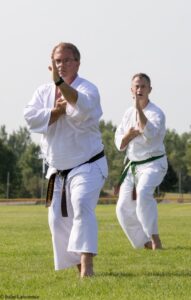
It is always a special moment when my Sensei says, “Let’s learn a new kata.” It happened for me just this past weekend, and over eight years into my training, it is still a thrill. While I know that there is always more to learn within the kata I already know, there is something undeniably invigorating to learning a new kata.
After I learn a new kata from my Sensei, after class has finished, the first thing I do is to run through it, on my own. Sometimes that happens while I’m still on the deck, but more often, it happens at home, while I’m still in my gi, the moves still fresh in my mind and in my body. I work through it, half-speed and power, recording what I’ve learned into my whole mind and whole body. When I inevitably run into something I cannot remember, I make a mental note to come back to it, and see what else I can remember.
After a shower, my subconscious has had a moment to do some work. I’ll sit down to have a glass of water, and I’ll spend a moment visualizing the kata to see how much I can remember now.
Following that, as someone who learns well from visual input, I will usually open the Kata Guide videos, and watch Hanshi’s video of the kata. (For those learning Fukyugata Ichi, see the USRK homepage for Hanshi’s video of the kata.) This not only fills in the gaps in my memory, but I can often pick up some of the nuances that have escaped me so far. For completeness, I will usually search the 55th Anniversary app, or search the internet to find if are any other Ueshiro Shorin-Ryu videos of the kata, to round out my understanding.
Finally, I’ll practice the kata a few more times at half-speed, to drill it in once more before I leave it alone until the next class comes along.
From there on, I usually have the sequence of moves more or less memorized enough that I can begin focusing on the transitions between the moves. I can drill the moves, committing them to muscle memory. I can find where the power comes from and figure out the footwork, so I can maintain balance and speed. And I can practice, practice, practice to truly commit the kata to memory.

If all of that goes well, over the following weeks, months, and years, I can delve into deeper meanings of the kata. I can understand the application of a set of the kata’s techniques. I can recognize a sequence from another kata that I know, compare them for differences, and see what more I can learn from these subtleties. And that learning continues each time I perform any of my kata.
Inevitably, learning one new kata makes all of my kata better. The new kata sometimes gives me a new perspective on a technique that I can then apply to other kata that I know. Or more broadly, having a new kata in my mind and in my body shows me more ways to understand myself and how I think and move.
Whatever the case, practicing kata is at the heart of my Karate. I am grateful to the masters of the past for composing our kata. I am grateful to all the karateka through history who have passed them down through time. And I am grateful to Master Ueshiro for bringing the kata to us from Okinawa, and to Hanshi Scalione, the Kyoshi, and my Sensei for continuing to keep the kata alive today.
