Classes
If you are interested in our Karate, please come watch or participate in a session. Our mission is to bring Ueshiro Shorin-Ryu Karate to the greater Carleton College community, including all students, faculty, staff, alumni, and friends. We welcome all who wish to train with us. Questions are always welcome.
Class Schedule
During the term, Carleton classes meet three times per week in the Cowling Gymnasium Dance Studio.
- Tuesday: 4:00pm – 5:10pm
- Thursday: 4:00pm – 5:10pm
- Saturday: 10am-11am, advanced belts continue 11am-noon
- All Carleton Karate Club and PE class members are strongly encouraged to attend the Saturday workouts, which we share with the Ueshiro Northfield dojo
Additionally, the Ueshiro Northfield dojo’s classes meet Monday and Wednesday evening, from 6:45pm-8pm all year round. If Carleton deshi (students) are interested, those class meetings are also available – ask the Shihan if you any questions.

What to Expect
At the Ueshiro Carleton Karate Dojo, we train a traditional, self-defense style of karate as part of the Ueshiro Shorin-Ryu Karate USA organization. You won’t see a lot of flying kicks or free-sparring on the deck, but you will work hard and build focus, strength, balance, and spirit. We focus on self-improvement, and we encourage the Zen concept of Sho-shin: beginner’s mind.
For your first class
Especially for PE students, the most important things to know are:
- Show up on time
- Wear comfortable workout clothes (no jeans)
- Follow along as best you can
We welcome visitors who want to watch a class before joining!
Our parent style, Matsubayashi-Ryū, emphasizes natural stances and practical self-defense techniques. Our particular take on Matsubayashi-Ryū comes from Master Ansei Ueshiro, whose karate stance was low and whose techniques were full of enormous power. We strive to reach the high bar he set for us.
Our dojo follows traditional Japanese etiquette. Please be aware of these norms, as they not only give our class sessions structure, but they are also a part of our training in self-discipline.
In the beginner’s mind, there are many possibilities, but in the expert’s mind there are few.
Shunryū Suzuki, Zen monk
The Workout
As part of the long traditions brought to us by Master Ueshiro, we honor the time-tested wisdom of our predecessors, and structure our classes as they have been taught for over a hundred years:
- We begin with a brief meditation, clearing the mind and body, and preparing to focus on our training
- We honor the Shinden – our teachers, and their teachers
- We show our respect to the instructor
- Warm-ups, including stretching and basic calisthenics to prepare the body
- Kihon (basics) to practice and hone our fundamental techniques and stances
- The rest of the class session includes a mix of kata (forms or routines), yaku-soku kumite (pre-arranged fighting), and other techniques and conditioning exercises
- We end with cool-downs and stretching
- And then close with another brief mediation, re-centering our minds and calming the body
Kata
On the surface, kata are predefined sequences of techniques that look like one side of an imaginary fight. While that is true, there are many layers of meaning embedded both in the act of practicing kata, and in the techniques of kata themselves. We strongly emphasize the study of kata in our Karate practice.
Corrections
During class, everyone on the deck gets corrections. If you watch, when a correction is given, even the black belts will check themselves to incorporate the correction into their practice.
Corrections are given to help you improve yourself. They are not a form of scolding – we are all here to help one another’s Karate get better. Please take corrections in the spirit they are given, and always thank the instructor or senior student for their help with, “Arigato, Sempai” or “Arigato, Sensei”, using their correct title.
What to Wear
Beginners are invited to wear whatever comfortable workout clothes they wish to wear. As you progress in your training, a Karate gi (uniform) is recommended. If you are invited to test for rank, you must wear a plain white gi with our patch over the left lapel.
If you wish to purchase a gi, we suggest a lightweight, 100% cotton gi, and a common source for these is Ki International, though there are many other suppliers – please remove any logos or visible tags. For Carleton students, the Karate Club has a variety of gis available to borrow for testing days – contact the club officers for more information.
You may purchase a patch from the Shihans (directors) of the Carleton or Northfield dojos, or the club’s gi may already have one applied.
What Not to Wear
Please remove jewelry, watches, and other items that may catch on clothing or injure you or other deshi (students) during class.
Karate is best practiced barefoot, especially on the wood floor of the dance studio. Remove your shoes and socks for safety.
Instructors
The Ueshiro Carleton Karate Dojo is under the direction of Sempai David Huyck, Ni-Dan, and Carleton alum from the class of 1998. Our dojo is closely affiliated with the Ueshiro Northfield Shorin-Ryu Karate dojo, run by Sensei Steve Hatle, Yon-Dan.
“To teach kata is to learn kata,” and from that maxim applied to life, an unbroken cultural chain is created and sustained. This is karate-do.
Hanshi Robert Scaglione, from the Introduction to “the Red Book“
During the academic term, most weekday classes will be instructed by Sempai Huyck. Most Saturday classes will be mixed with the Northfield dojo, and may be taught by Sensei Hatle, Sempai Huyck, or another of the senior belts.
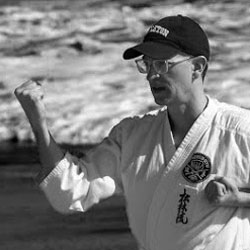
Sempai David Huyck, Ni-Dan
Shihan of the Ueshiro Carleton Karate Dojo
Sempai Huyck began training with his eldest child in 2016. They both earned the rank of Sho-Dan in 2023, and David advanced to Ni-Dan in 2025. The other members of Sempai Huyck’s family also train together in the Northfield dojo.
David is also a Carleton alum – he majored in Studio Art. He also works at the college as a Senior Web Application Developer for the college’s main website.
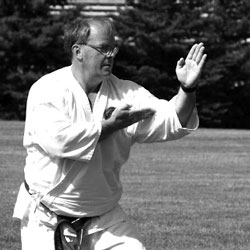
Sensei Steve Hatle, Yon-Dan
Shihan of the Ueshiro Northfield Shorin-Ryu Karate Dojo
Sensei Hatle began his training under Sensei Bob Dobrow in 2008, and became Shihan of the dojo in 2017. He achieved the rank of Yon-Dan in 2024.
Sensei Hatle led both the Northfield and Carleton classes until 2024, when he encouraged Sempai Huyck to become Shihan, and establish the Carleton student as a separate dojo.
Other instructors include the black belts and other senior students of the two dojos, including:

San-Dan
San-Dan (emeritus)
Ni-Dan

Sho-Dan

Sho-Dan

Sho-Dan
In Memoriam

In February 2025, our community lost Sempai Sylvester Huyck. They were admired and celebrated by many across our organization. We carry their inspiration and their teaching forward, as we continue to train with the spirit they demonstrated each time they stepped onto the deck.
Rank & Testing
Rank is as much a responsibility as it is a privilege!
Hanshi Robert Scaglione
The focus of our traditional karate-do is not on promotions and belt colors, but rather on training and diligent practice of kata. Ueshiro Shorin-Ryu Karate dojos may run kyu-rank testing every two months, and full-belt testing (green belt and above) twice a year, in February and August. Testing is by invitation of the shihan (dojo director), but there is never any obligation to test.
We all begin as white-belts.
Karate is half physical exercise and half spiritual. The karateka who has given the necessary years of exercise and meditation is a tranquil person. They are unafraid. They can even be calm in a burning building.
Mas Oyama, founder of Kyokushin Karate
