Resources
There are many Ueshiro Shorin-Ryu dojos around the world, and many of them have excellent websites with more information than is provided below. Start here, but feel free to explore the websites of other dojos in our system for more great resources.
Obtaining a Uniform (Gi)
The karate gi is an iconic outfit for karateka around the world. In our style we recommend a light-weight 100% cotton gi, with any logos removed. If you test for rank, you will be required to wear our Shorin-Ryu patch on the left lapel. Carleton students and Club members may be able to borrow a gi from the Karate Club. Contact the officers for more information.
There are many places to buy a gi online or in the Twin Cities. Some recommendations:
- Ki International: http://www.kiintl.com/
Select the Karate Gi in the navigation, then select the Lightweight option. 100% cotton tends to be more comfortable. - Century Martial Arts: https://centurymartialarts.com/collections/karate-uniforms
You can buy tops and bottoms separately or as a set. - Rising Sun Martial Arts Supply in St. Paul: http://www.risingsunmartialartssupply.net/
On sizing: The gi should be loose-fitting. Each company’s sizing chart is usually based only on height. Depending on your body build you may want to order one or two sizes larger than their chart recommends, and you may need to hem the legs and/or sleeves for proper length and comfort.
Frequently Asked
The reason we are all here is because we are curious, and we embrace the spirit of “sho-shin”: beginner’s mind. Never hesitate to ask a question – Master Nagamine quoted the following on the first edition cover of his book, The Essence of Okinawan Karate-do: “To ask may be a moment’s shame; but to remain in ignorant silence is a lifelong shame.”
- May I watch a class before I sign up?
Please do! It is certainly not a requirement, but if you are curious about Karate, or you have trained another style or another martial art, come see what our classes look like. A single visit cannot give you a complete picture, but it should give you a decent sense of our practice. If you do come to watch, please be sure to introduce yourself to the instructor or other senior students, and ask any questions you might have. - What type of style is Shorin-Ryu?
Shorin-Ryu is a traditional, Okinawan style of karate that relies on natural stances with little wasted motion and no exaggerated breathing. We focus on repetition of practical self-defense techniques, and the performance of kata — ancient pre-arranged forms that simulate defensive and offensive moves against attackers. There is no technique, if done properly, that poses risk of self-injury. - Is this a complete workout?
In a single, one-hour class, you will train upper and lower body; calisthenics, flexibility, and cardio; balance, breathing, and self-discipline; meditation, self-awareness, and focus; and more. Most of our techniques are body-weight only, and you can practice them anytime, anywhere — but we will also do some exercises with weights, training partners, or striking pads. Ideally, a beginner might train two or three times per week; an advanced student will likely train three, four, or more days each week. - Do you practice sparring in class?
No. While some styles promote free-style sparring, we believe it detracts from the “life and death” premise behind true karate and reduces the art to a competitive sport. Our training capitalizes on the element of surprise, and it is designed to inflict serious or lethal injury in as few moves as possible. Regular sparring with protective equipment and rules limiting contact undermines these goals. Techniques become sloppy which may lead to injuries.
Some of our parter work does include person-to-person contact. Learn more about yaku-soku kumite and bunkai.
Learn more about our instructors, what to expect, class times, and more.
Glossary
We use a mix of Japanese and English terms in the classes, and with time they will become second-nature. In the meantime, here are some of the terms we use the most.
Onegai Shimasu
This Japanese term (pronounced “oh-nay-guy shee-mah-ss(oo)”) can be translated a number of ways, but the most important to us is “please teach me” or “let’s experience this together.” A new white belt will say this to an 8th-degree black belt, but the 8th-degree black belt will say it back to the white belt, too. As we progress in our karate, we continue to learn from everyone – from their individual experiences, from their different physical abilities and limitations, and from the act of teaching itself. Onegai shimasu is our invitation to take care of one another, and to train with respect and courtesy.
Rei
Do not forget that Karate-do begins and ends with rei.
Master Gichin Funakoshi
“Rei” (pronounced “ray”) means courtesy or respect. On the deck, when we physically show “rei”, we bow at the waist. But all throughout our Karate practice we show courtesy – to our training partners, to the shinden, to the kata, and more. By taking a moment to reflect on these things, we give ourselves an opportunity to show gratitude to the people, traditions, and even the space where we train, and how they have all made our training possible.
Arigato
“Thank you.” In Japanese, the polite form is arigatō gozaimasu, or can be said with emphasis (thank you very much), domo arigatō gozaimasu.
We express our gratitude on the deck frequently. During training, we all receive corrections from our instructors and the senior students. These corrections are not meant as an admonishment, but as help in improving our Karate. When we receive a correction, we say thank you: “Arigatō, sensei!”
Kata
Karate is an art, a study, and a practical application of an integrated philosophy. It embodies physical, emotional, and spiritual values which may be applied to all phases of one’s everyday life. To accomplish this there exists one simple vehicle. That vehicle is kata, the essence of karate. Kata embodies all the secrets, the mystery, the physical, mental, emotional and spiritual concepts of the masters. Kata is the key, the answer, the solution to everything that we search for in karate. Kata is zen. Kata is simple yet difficult.
Hanshi Robert Scaglone, in the introduction to “the Red Book“
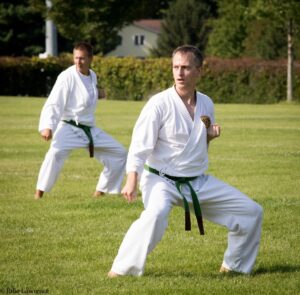
Kata are one of the cornerstones of our style. Kata, or “forms,” are a predetermined sequence of movements and techniques that can be practiced solo.
Embedded in the moves of the kata are combinations of techniques that represent strikes, defense, grappling, or the take-down of an attacker. Embedded in the art of performing kata is a “moving zen” meditation, where we lose ourselves to the moment, and calm our spirit within the flow of the moves.
A video of Hanshi Robert Scaglione performing our first kata, Fukyugata Ichi, is on the homepage of the Ueshiro Shorin-Ryu website.
In class we will often perform around a dozen kata as part of our workout, and occasionally we will hold a “kata-thon”, performing as many kata as we can in an hour or two-hour session. Over our Karate careers, we will likely perform thousands of kata, fine-tuning our technique, power, balance, and focus — always seeking the elusive experience of mushin, “empty mind”.
There are many kata in the world, and different styles will study and emphasize a different set of kata according to their traditions. We study 19 different Kata in Ueshiro Shorin-Ryu:
- Fukyugata I, II, and III
- Pinan I, II, III, IV, and V
- Naihanchi I, II, and III
- Ananku
- Wankan
- Rohai
- Wanshu
- Passai
- Chinto
- Gojushiho
- Kusanku
Fukyugata San (III) is particularly important to our style, as it was composed by our founder, Master Ueshiro. Fukugata Ichi (I) was composed by his teacher, Master Nagamine. The origins of other kata are listed in the Red Book.
Yaku-Soku Kumite
Yaku-soku kumite – “pre-arranged fighting” – are a set of practiced drills where partners perform coordinated attacks and defenses. In Ueshiro Shorin-Ryu, we have four different yaku-soku kumite exercises. The benefit of these pre-arranged fights is that the deshi (students) – with practice – can throw their techniques at full-speed and full-power, knowing that their training partner will be prepared to block or evade the technique. It gives students a chance to practice their reactions, adaptability, and focus with a real opponent.
Tanren Kumite & Bunkai
We also practice body conditioning, or tanren kumite, such as “three-point arm training” or “high-low.” These partner exercises harden the bones and strengthen the muscles to be able to better withstand impact. These exercises also train focus and control, giving us an opportunity to adjust our techniques to different partners and abilities.
Bunkai is an activity where we practice the potential applications of our techniques, especially in the context of our kata.
In all of these activities — yaku-soku kumite, tanren kumite, and bunkai — we make person-to-person contact with our fellow students and training partners.
Oyo-Tan-Ren
Special Exercise Oyo-Tan-Ren is an alternative way to train our basic moves. The name comes from oyo, meaning “analysis” or “practical use”, and tanren, meaning “training”, or in metalwork, “to harden” or “forge”. Together, it suggests that we harden ourselves and build our foundation through training of our basic moves. Composed by Master Ueshiro, the exercise consists of 50 moves total, moving in a straight line up and down the deck. This is a requirement for the green belt test, and a diagram of the exercise is available on page 31 in the “Red Book”.
Other Terms and Definitions
Numbers/Counting
There are many good, short videos, where you can hear the pronunciations. Here’s an example, or here’s another 🦆.
- Ichi (“ee-chee”): one
- Ni (“nee”): two
- San (“sahn”): three
- Shi (“shee”): four (typically, Japanese speakers use “yon” for four, but we use “shi”)
- Go (“goh”): five
- Roku (“roh-koo”): six
- Shi-chi (“shee-chee”): seven (more commonly, “nana”, but again, we use “shi-chi” in Karate)
- Hachi (“hah-chee”): eight
- Kyuu (“kyoo”): nine
- Ju (“jyoo”): ten
Commands we use on the deck
- Shugo (“shoo-goh”): line up
- Kiotsuke (“kyoh-tskeh”): stand at attention
- Yoi (“yoy”): get ready
- Hajime (“hah-gee-may”): begin
- Yame (“yah-may”): stop
- Mawate (“mah-wah-tay”): (get ready to) turn around
Striking, Blocking, and Stances

- Tsuke (“tzoo-kay”): punch
- Jo-dan tsuke (“joh-dahn tzoo-kay”): high (nose-level) punch
- Chu-dan tsuke (“choo-dahn tzoo-kay”): middle (solar-plexus-level) punch
- Gei-dan tsuke (“gay-dahn tzoo-kay”): low (stomach- or belt-level) punch
- Oi-zuke (“oh-eh zoo-keh”): chasing punch
- Uraken-uchi (“ooh-rah-kehn ooh-chee”): back-fist strike
- Uke (“ooh-kay”): block or receive
- Jo-dan uke (“joh-dahn ooh-kay”): high block
- Chu-dan uke (“choo-dahn ooh-kay”): middle or chest block
- Gei-dan barai (uke) (“gay-dahn bah-rye ooh-kay”): low sweep(ing block)
- Shuto-uke (“shoo-toh ooh-kay”): open-hand (knife-hand) block
- Keri/Geri (“keh-ree”/”geh-ree”): kick
- Mae-geri (“mah-yeh geh-ree”): front snap-kick
- Hiki-te (“hee-kee tay”): “pulling hand”, the hand opposite the named technique — the hand pulls into the “pocket”
- Dachi (“dah-chee”): stance(s)
- Shizentai dachi (“shee-zen-tye dah-chee”): natural [walking] stance
- Jigotai dachi (“jig-oh-tye dah-chee”): horse-riding stance (some styles call this “kiba-dachi”)
- Zenkutzu dachi (“zen-koo-tsoo dah-chee”): low [forward] stance
- Neko-ashi dachi (“neh-koh ah-shee dah-chee”): cat [foot] stance
- Kosa dachi (“koh-sah dah-chee”): cross-legged stance
- Naihanchi dachi (“nye-hahn-chee dah-chee”): a variation on horse-riding stance with the feet straight and knees pressed outward
Other common terms
One who conquers oneself is the greatest warrior.
Karate precept

- Dojo (“doh-joe”): the training gym
- The deck: the floor of the dojo, but also a reference to the dojo space itself, as in “on the deck”. This can apply to any surface or space where one practices Karate — the gym, the grass, the beach, your hotel room, etc. Karate can happen anywhere.
- Gi (“ghee” with a hard “g”): the karate uniform
- Obi (“oh-bee”): belt
- There are many ways to tie an obi. The way our dojo ties the obi can be found in the Red Book.
- Seiza (“say-zah”): sit kneeling on the tops of your feet
- Anza (“ahn-zah”): sit cross-legged
- Migi (“mih-ghee”): right (side)
- Hidari (“hee-dah-ree”): left (side)
- Te (“tay”): hand
- Ashi (“ah-shee”): foot, leg
- Tanden (“tahn-dehn”): center, just below and behind the navel
- Sometimes separated into Ju-tanden (center of the head, behind the “third eye”), chu-tanden (center of the chest, behind the sternum), and seika-tanden (the center of the body, just below and behind the navel)
- Koshi (“koh-shee”): hips, or small-of-the-back
- Dozo (“doh-zoh”): please
- Ma-ai (“maaee”, one syllable): distance from your opponent
- Different from mae (“mah-eh” or “maaee”, one syllable): forward, or in front. As in “hidari ashi mae” – left foot forward.
- Kime (“kee-may”): focus
- Chiishi (“chee-shee”): a traditional one-sided weight used for conditioning
- Makiwara (“mah-kee-wah-rah”): a lightly padded board that a karateka strikes with the hands and feet to practice aim and form, and to harden the bones and muscles
- Kobudo (“koh-boo-doh”): traditional Okinawan weapons
- In our style we have the Bo (Master Ueshiro’s favored weapon), Nunchaku, Tuifa (sometimes called Tonfa), Sai, and Kama
Ranks and Titles
- Kyu-ranks (“kyoo-ranks”): pre-black-belt ranks
- We all begin as a White Belt. In Japanese: Shiro-obi, or sometimes Shichi-kyu.
- Ro-kyu: one green tip.
- Go-kyu: two green tips,
- Yon-kyu: green belt.
- San-kyu: green belt with brown tips.
- Ni-kyu: brown belt.
- Ik-kyu: brown belt, black tips.
- Dan-ranks (“dahn-ranks”): black belt levels
- Sho-dan: first-degree black belt. Literally translates to “beginner level.”
- Ni-Dan: second-degree black belt.
- San-dan: third-degree black belt. Confers the title, Sensei.
- Yon-dan, Go-dan, Roku-dan: fourth, fifth, sixth-degree black belts.
- Shichi-dan, Hachi-dan, Kyuu-dan: seventh-degree, eighth-degree and ninth-degree black belts. Often comes with the title, Kyoshi.
- Ju-dan: tenth-degree black belt. Held by Hanshi Robert Scaglione.
- Deshi (“deh-shee”): student, usually below black-belt
- Sempai (“sehm-pye”): senior student
- Sensei (“sehn-say”): teacher (San-Dan or above)
- Kyoshi (“kyoh-shee” or “kee-oh-shee”): professor or expert teacher (Shichi-Dan or above)
- Hanshi (“hahn-shee”): master teacher (Ju-Dan)
- Shihan (“shee-hahn”): director of an individual dojo, “teacher of teachers”. This word means different things in different schools, but for us, it designates who runs a particular dojo.
- Shinden (“shin-dehn”): those who came before. Our teachers, and their teachers, on into history.
- Karateka (“kah-rah-teh-kah”): Karate practitioners
This video includes a collection of pronunciations of techniques and terms — note that Yusuke Sensei in the video practices Shotokan, so some of the terms do not match our terms (for example, he says “age uke” where we would say “jo-dan uke”). Also note that he is from Tokyo and speaks proper Japanese, so some of his rules about when a term applies (such as Sempai) are not the rules we follow in our system.
Reading Materials

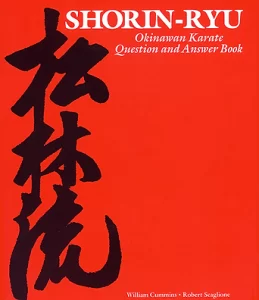
There are many books about karate available. Of particular interest to Ueshiro Shorin-Ryu are four main books. The Red Book and the Green Book can be purchased from the dojo, and your Shihan can help you find others:
- Shorin-Ryu Okinawan Karate Question and Answer Book (a.k.a. “The Red Book”), by Hanshi Robert Scaglione and William Cummins
- Building Warrior Spirit With Gan, Soku, Tanden, Riki (a.k.a. “The Green Book”), by Hanshi Robert Scaglione and William Cummins
- The Essence of Okinawan Karate-Do, by Master Shoshin Nagamine
- 50th Anniversary Commemorative Journal, published by Ueshiro Shorin-Ryu Karate USA
Additionally, there are other books we regularly refer to and discuss in our training:
- The Book of Five Rings: Miyamoto Musashi – there are many translations, and the Victor Harris translation, Overlook Press is preferred
- Tales of Okinawa’s Great Masters, by Master Shoshin Nagamine
- Karate-Do: My Way of Life, by Gichin Funakoshi
- The Twenty Guiding Principles of Karate, by Gichin Funakoshi
- Moving Zen, by By C.W. Nicol
- The Karate Dojo, by Peter Urban
Teach them to step first!
Master Ansei Ueshiro

